
Shockwave vs. Cortisone Injections
Cortisone Buys You Time. It Doesn’t Buy You Tissue.
A cortisone shot can be the right call — and it can also be the reason you’re still here two years later. Here’s the honest comparison, from a Doctor of Physical Therapy in Chula Vista who has no financial reason to talk you out of either one.
Start Here
What Cortisone Is Genuinely Good At
Fast, Powerful Relief
Corticosteroid is a potent anti-inflammatory. When pain is severe enough that you can’t sleep or can’t begin rehab, a shot can break that cycle within days.
Diagnostic Value
If a targeted injection relieves the pain, that tells your physician something useful about where the pain is coming from.
Widely Covered
It is usually covered by insurance and available quickly through most orthopedic and primary care offices.
We are not anti-cortisone. We refer patients for injections when it is the right tool. The problem is what happens when it becomes the only tool.
The Catch
Why The Relief Keeps Running Out
Cortisone suppresses the inflammatory signal. It does not build blood supply, it does not reorganize degenerated tendon, and it does not restore load tolerance. The underlying tissue is the same tissue the day after the shot as the day before.
The Pattern Most Patients Describe
Shot #1: excellent relief, lasts several months. Shot #2: good relief, doesn’t last as long. Shot #3: “it didn’t really do much this time.” Each round of relief is shorter because nothing changed structurally.
What The Research Raises
Studies on corticosteroid injection for tendon problems have repeatedly found excellent short-term relief but no advantage — and sometimes worse outcomes — at 6 and 12 months compared with conservative care. Repeated injections around tendon have also been associated with weakening of the tissue.
Side By Side
Shockwave + EMTT vs. Cortisone Injection
| Shockwave + EMTT | Cortisone Injection | |
|---|---|---|
| What it does to the tissue | Stimulates new blood supply and repair | Suppresses inflammation; no structural change |
| Speed of relief | Gradual — often noticeable by session 2–3 | Fast — often within days |
| How long it lasts | Improvement typically continues after the final session | Weeks to months, often shorter with each repeat |
| Needles | None | Injection into or near the tendon/joint |
| Effect on tendon strength | No known weakening | Repeated injections may weaken tendon tissue |
| Limit on how many | No hard cap — typically 4–6 total | Physicians typically limit per site per year |
| Downtime | None | Often 24–48 hrs; flare is common |
| Insurance | Usually not covered (cash-pay) | Usually covered |
| Best used when | Pain has lasted 6+ weeks and hasn't responded to rest | Pain is severe enough to block sleep or rehab |
Practical Answer
How We Actually Think About It
These two aren’t really rivals. They’re doing different jobs on different timelines.
1
If you’ve never had one
And the pain is chronic rather than acutely disabling, shockwave is a reasonable first move — it addresses the tissue itself, with no cap on how many times you can return to it.
2
If you’ve had one and it wore off
This is the most common story we see. The shot proved the pain is coming from that structure. Now the structure itself needs to be treated. That’s exactly what shockwave targets.
3
If you’ve had two or three
Talk to us before booking another. Repeated injections into the same tendon carry real trade-offs, and there is another path that doesn’t involve them.
Questions
Cortisone & Shockwave FAQ
I just had a cortisone shot. Can I still do shockwave?
Usually yes, but timing matters. Most clinicians prefer to wait several weeks after an injection before starting shockwave so the healing response isn’t blunted by the steroid still in the tissue. Bring the date of your injection when you get in touch and we’ll plan around it.
Can I do both?
Sometimes that’s the smartest sequence — an injection to calm severe pain enough to tolerate rehab, then shockwave to repair the tissue underneath. We coordinate with your physician when that’s the plan.
Is shockwave painful compared to an injection?
Different kind of discomfort. Shockwave is a deep, firm thumping for 5–10 minutes with no needle and no numbing required. Most patients find it far easier than they expected.
Why isn't shockwave covered by insurance if it works?
Coverage lags evidence, particularly for treatments that reduce the number of billable visits. Most US insurers still classify shockwave as investigational for many musculoskeletal conditions even where it’s standard of care elsewhere. We keep our pricing transparent.
What if shockwave doesn't work for me?
Then we tell you, and we help you figure out the next step — including referring you back to an orthopedist. We’d rather lose the sale than sell you eight sessions of something that isn’t going to help.
Your Next Step
Get A Straight Answer Before You Decide
Before you commit to another injection, find out whether your problem is one shockwave actually solves — and what it would cost. Asking costs you nothing.
Ask What Shockwave Costs
— And Whether You're A Candidate
One short form. A real conversation with our team.
On that call you'll get
✓ A straight answer on whether shockwave is likely to help your specific problem
✓ What a typical course involves — how many sessions, how far apart
✓ Exactly what it costs
✓ Whether something else would serve you better — including a referral elsewhere if that's the honest answer
✓ A time that works, if you decide to come in
No insurance required. No obligation. We'll come back to you within one business day.
Prefer to just ask? Call and we’ll answer the same questions on the spot.
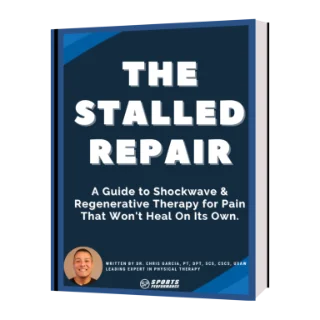
Before you book anywhere, read page 7
Most clinics that offer shockwave own one machine — usually the radial one. Radial energy spreads out near the surface, so if your problem sits deeper than that, it does not reach it.
Page 7 of our free guide explains the difference, roughly where your own problem sits, and what to ask before you book anywhere. Fourteen pages. No cost.
Send me the free guide →Comparisons on this page describe treatments in general terms and are not a substitute for a conversation with your own physician or surgeon.