
Heel & Foot · Chula Vista · South Bay
Plantar Fasciitis & Heel Pain Treatment In Chula Vista
If the first ten steps out of bed are the worst part of your day, and it has been that way for months, the problem is no longer inflammation. It’s tissue that stopped healing. That is exactly what shockwave is built to restart.
✓ Non-surgical ✓ No injections ✓ No downtime ✓ 20–30 min visits
Start Here
What This Actually Is
The plantar fascia is a thick band of connective tissue running from your heel bone to the base of your toes. It works like a bowstring, holding the arch of your foot together every time you push off.
The name is misleading. “-itis” implies inflammation, and in the first few weeks that is what it is. But heel pain that has lasted more than about three months is usually plantar fasciosis — not an inflamed tissue, a degenerated one. Under a microscope the collagen fibres are disorganised, the blood supply is poor, and the normal repair process has simply switched off.
That distinction matters, because it explains why anti-inflammatories, ice and rest give you a few good days and then nothing. They are treating a problem you no longer have.
The Real Problem
Why It Hasn’t Gone Away On Its Own
The fascia is loaded with every single step. You cannot rest it the way you’d rest a shoulder — walking to the bathroom is a treatment session you didn’t choose.
Blood supply at the heel attachment is thin at the best of times, and it gets thinner with age and with the degeneration itself. Without circulation there is no delivery of the cells that rebuild tissue.
The classic morning pain is the tell: overnight the fascia shortens and the disorganised tissue knits together loosely. Your first steps tear that apart again. Every morning you restart the same failed repair.
The Treatment
How Shockwave And EMTT Address It
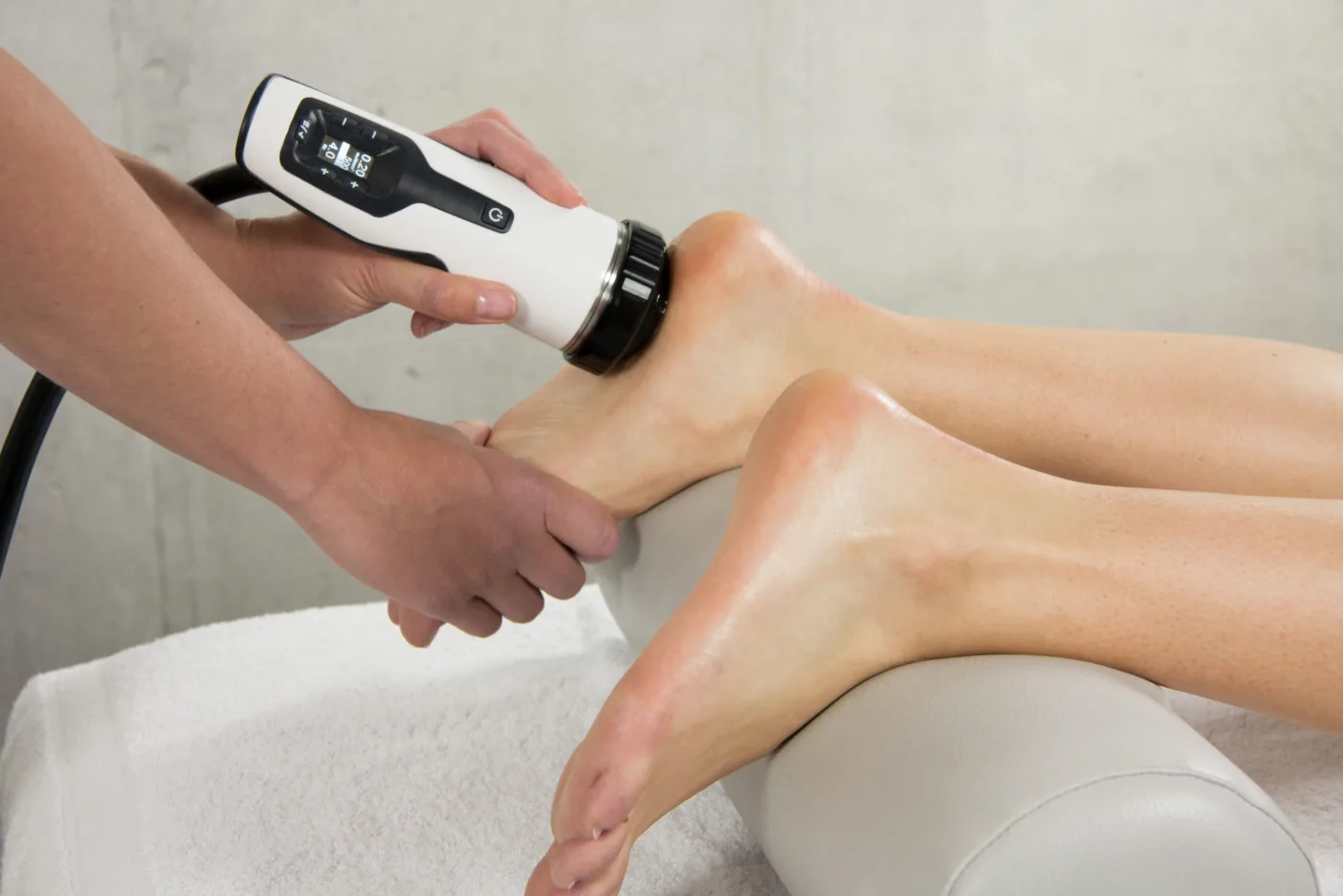
Shockwave delivers high-energy acoustic pressure waves into the tissue. The body reads that controlled stimulus as a fresh injury and reopens the healing process that stalled out. Here’s what that means for this specific problem.
Restarts the repair signal
Focused acoustic waves create a controlled micro-stimulus in the degenerated tissue. The body reads it as a fresh injury and reopens the healing cascade that had shut down — this time in tissue we can then load correctly.
Builds new blood supply
The waves trigger neovascularisation: the growth of new small vessels into an area that had almost none. This is the part that rest and stretching cannot do at all.
Turns down the pain signal
Shockwave affects the local nerve endings and the substance-P pain pathway, which is why many patients notice the morning pain easing before the tissue itself has finished remodelling.
Reaches the deep attachment
The painful spot in plantar fasciitis is usually where the fascia meets the heel bone — deep, and behind a thick fat pad. Focused shockwave delivers energy at that depth in a way surface treatments cannot.
What To Expect
What A Course Of Treatment Looks Like
Most heel cases run six to eight sessions, spaced about a week apart. Each visit takes roughly 20 to 30 minutes, and you walk out and drive yourself home.
You are not on crutches and you are not resting for six weeks. We usually ask you to avoid a hard run or a long hike for 48 hours after each session, and otherwise keep living your life.
Improvement is typically gradual rather than dramatic — the morning pain shortens from twenty minutes to five, then to a few steps. Tissue remodelling continues for weeks after the final session, so we reassess at about six to eight weeks, not the day you finish.
Straight Talk
Are You A Candidate?
Shockwave is genuinely good at a narrow set of problems. It is not good at everything, and candidacy is determined by examination, not by a website.
Shockwave Is Usually A Good Fit If
✓ Heel pain that has lasted longer than three months
✓ Pain that is worst on the first steps of the morning or after sitting
✓ You’ve already tried rest, orthotics, new shoes, stretching or night splints
✓ You’ve had a cortisone shot that helped for a while, or wore off
✓ You want to keep walking, working and training while you get better
When It Isn’t The Answer
✗ Sudden heel pain after a specific traumatic event — that needs imaging first, not shockwave
✗ Pain that is clearly coming from the nerve (burning, numbness, pins and needles into the foot) — tarsal tunnel and nerve entrapment are different problems with different answers
✗ A suspected calcaneal stress fracture — we’d send you for imaging before touching it
✗ Active infection, open wound or a tumour in the area, or if you’re pregnant
If you’re in this column we’ll tell you on the first visit and point you where you should actually go. We’d rather lose the case than sell you sessions that won’t help.
Not Just A Machine
What We Do Besides Point A Device At You
Most clinics that own a shockwave device deliver shockwave. You’re seeing a Doctor of Physical Therapy, so you also get a diagnosis and a plan for why the tissue failed in the first place.
Finding out why the fascia failed
Heel pain is a symptom of a load problem somewhere. Limited ankle dorsiflexion, a weak calf, a collapsing arch, a sudden jump in mileage or a job on a concrete floor. If we fix the tissue and not the cause, you’ll be back.
Calf and foot strength that actually holds
The single biggest protective factor for the plantar fascia is a strong, resilient calf complex. Loaded calf work — progressed properly, not three sets of fifteen forever — is part of every heel plan we run.
Footwear and load, honestly assessed
Sometimes the answer really is the shoes, or the mileage, or standing eleven hours a shift. We’ll tell you when that’s the lever, rather than selling you sessions.
Weighing Your Options
Already Been Offered Something Else?
If you have a cortisone shot, an injection or a surgery on the table, these compare them honestly — including where the alternative is the better choice.
Your Next Step
Find Out If This Is Your Problem
Ask What Shockwave Costs
— And Whether You're A Candidate
One short form. A real conversation with our team.
On that call you'll get
✓ A straight answer on whether shockwave is likely to help your specific problem
✓ What a typical course involves — how many sessions, how far apart
✓ Exactly what it costs
✓ Whether something else would serve you better — including a referral elsewhere if that's the honest answer
✓ A time that works, if you decide to come in
No insurance required. No obligation. We'll come back to you within one business day.
Prefer to just ask? Call and we’ll answer the same questions on the spot.
Sports Performance Physical Therapy
861 Harold Place, Unit 307 · Chula Vista, CA 91914
(619) 397-1391
Mon–Thu 9:00am–6:00pm · Fri 8:00am–5:00pm
Serving Eastlake, Bonita, Otay Ranch, National City, Imperial Beach and San Ysidro. Kearny Mesa location also available.
Before you book anywhere, read page 7
Most clinics that offer shockwave own one machine — usually the radial one. Radial energy spreads out near the surface, so if your problem sits deeper than that, it does not reach it.
Page 7 of our free guide explains the difference, roughly where your own problem sits, and what to ask before you book anywhere. Fourteen pages. No cost.
Send me the free guide →Shockwave Therapy Chula Vista is a service of Sports Performance Physical Therapy. Shockwave therapy is not appropriate for every patient or every condition. Always consult a qualified healthcare provider about your specific condition.