
Questions · Chula Vista · South Bay
Shockwave Therapy: Your Questions, Answered Straight
33 of the questions we actually get asked, answered the way we’d answer them on the phone — including the ones where the honest answer is “this probably isn’t for you.”
✓ Non-surgical ✓ No injections ✓ No downtime ✓ 20–30 min visits
The Basics
What is shockwave therapy, actually?
High-energy acoustic pressure waves delivered through the skin into the tissue underneath. The body reads that controlled stimulus as a fresh injury and reopens the healing process that stalled out. Nothing is injected and nothing is cut. It is sometimes called ESWT (extracorporeal shockwave therapy) or EPAT.
Is it the same as the ultrasound or e-stim I had at another clinic?
No. Those deliver far lower energy and are generally used to manage symptoms during a session. Shockwave delivers enough mechanical energy to provoke a biological response in the tissue. It’s a different category of treatment, which is also why it feels different.
What's the difference between shockwave and EMTT?
Shockwave uses acoustic pressure waves and is targeted to a specific structure. EMTT uses high-energy magnetic pulses that pass painlessly through an entire joint or region, reaching depth and volume that shockwave can’t. We use them together because they do different jobs.
Why do you talk about having three devices?
Most clinics that offer shockwave own one machine and use it on everything. We use focused shockwave, radial pressure waves and EMTT, because a deep hip problem and a surface-level tendon problem don’t respond to the same tool. Having the choice is what lets us match the device to the tissue.
What Treatment Is Like
Does shockwave therapy hurt?
You’ll feel a firm, deep thumping — most clients describe it as intense but tolerable, and we adjust intensity throughout. Treatment on the area lasts about 5 to 10 minutes. Some soreness for a day or two afterward is normal and is actually part of the healing response.
How long is an appointment?
Usually 20 to 30 minutes door to door. The shockwave portion is the short part; the rest is assessment and the hands-on work that goes with it.
Is there any downtime?
None. You drive yourself home and go back to your day. We usually ask you to avoid high-impact activity for 24 to 48 hours after each session so the healing response isn’t interrupted.
Can I keep training or working out?
In most cases yes, with adjustments. We’d rather modify your training than stop it — but we’ll tell you honestly if continuing to load the tissue is the reason it hasn’t healed.
What should I bring or wear?
Clothing that gives us access to the area being treated. If you’ve had imaging — X-ray, MRI, ultrasound — bring the report. It genuinely changes the conversation.
Results & Timeline
How many sessions will I need?
Most conditions respond in 6 to 8 sessions, typically once a week. Longstanding or deeper problems sometimes need more. You’ll get a realistic number when we speak — before you commit to anything.
How soon will I feel a difference?
Many clients notice a change within 2 to 3 sessions. Because shockwave works by rebuilding tissue rather than numbing pain, the biggest improvements often continue for weeks after the final session.
How long do the results last?
When shockwave works, it works by changing the tissue, so the result isn’t on a timer the way a cortisone shot is. What it can’t do is protect you from whatever caused the problem in the first place. That’s the part your plan has to address.
What if it doesn't work for me?
That happens, and we’d rather say so now than after you’ve paid for eight sessions. If you’re not responding, we stop and reassess rather than selling you more of the same. Sometimes the answer is a different tool, and sometimes it’s a referral to someone else.
Do I need to do exercises as well?
Almost always. Shockwave restarts healing; loading the tissue correctly is what makes the repair durable. You’re seeing a Doctor of Physical Therapy, so that plan comes as part of it rather than as an upsell.
Safety & Who Shouldn’t Have It
Is shockwave therapy safe?
For appropriate candidates it’s a well-tolerated, non-invasive treatment. The common side effects are short-lived: soreness, redness or minor swelling in the treated area for a day or two. It avoids the risks that come with injections and surgery because nothing enters the body.
Who is NOT a candidate for shockwave?
Shockwave is generally not appropriate over active infection or open wounds, over a known tumor, in people on blood thinners or with a bleeding disorder, during pregnancy, or directly over growth plates in children. We screen all of this before we ever treat you.
I have a pacemaker / metal hardware / a joint replacement. Can I still have it?
It depends on what and where, and it’s exactly the kind of thing that gets decided on examination rather than over the internet. Tell us when you call and we’ll give you a straight answer before you come in.
Are there conditions where you'd turn me away?
Yes, and we do. If your problem is structural in a way shockwave can’t reach, or if the honest answer is that you need an orthopedic opinion, we’ll tell you on the first visit and point you where you should actually go. We’d rather lose the case than sell you sessions that won’t help.
Cost & Insurance
Do you take my insurance?
Most insurers don’t cover regenerative therapies. We give you the full cost up front.
Why isn't the price on the website?
Because the honest answer depends on what you’ve got and how many sessions it needs. Ask us and we’ll tell you the whole figure on the phone, including whether we think it’s worth it in your case.
Conditions
What conditions do you treat with shockwave?
Most commonly plantar fasciitis and heel pain, Achilles tendinopathy, knee pain and osteoarthritis, hip and glute tendon pain, shoulder pain including calcific tendinitis, tennis and golfer’s elbow, hand and wrist pain, low back and muscle pain, shin splints and calf problems, and bones that aren’t healing. Each of those has its own page on this site.
My problem has been going on for years. Is it too late?
Longstanding problems are the ones shockwave is designed for. A tendon that has been painful for two years is usually a tendon whose healing process stopped, not one that’s still injured. Restarting it is the whole point of the treatment.
I don't have a diagnosis. Can I still come in?
Yes. Part of what you’re paying for is the examination. We’d rather work out what’s actually wrong than treat the label somebody else put on it.
Do you treat erectile dysfunction with shockwave?
No. There are clinics locally that do, and it’s a different service with different equipment and protocols. Everything we do is musculoskeletal — tendons, joints, muscle and bone.
Compared To Other Options
I already had a cortisone shot. Is it too late for shockwave?
Not usually. Many of our clients come to us after cortisone wore off. Bring your imaging and reports and we’ll give you a straight assessment of whether shockwave is a realistic option for your case. There’s a full comparison of the two on our Shockwave vs. Cortisone page.
I'm scheduled for surgery. Should I try this first?
Sometimes yes, sometimes no, and it depends entirely on what the surgery is for. If you have a mechanical problem that needs fixing mechanically, shockwave won’t fix it and we’ll say so. Our Shockwave vs. Surgery page walks through where each one wins.
How does it compare to PRP or stem cell injections?
They’re aiming at a similar goal by different means — one provokes the healing response from outside, the other introduces material. Cost, invasiveness and evidence differ. We compare them honestly on the Shockwave vs. PRP & Stem Cell page, including where injections are the better choice.
Isn't this just physical therapy with an expensive machine?
No, and it isn’t a replacement for physical therapy either. Shockwave restarts a stalled healing process; rehab rebuilds capacity so it holds. Clinics that only own the device give you half of that. Our Shockwave vs. Physical Therapy page explains the difference.
Your Visit
Where exactly are you?
861 Harold Place, Unit 307, Chula Vista, CA 91914 — just off Eastlake, with free parking directly outside the clinic. Call or text (619) 397-1391.
What are your hours?
Monday to Thursday, 9:00am to 6:00pm. Friday, 8:00am to 5:00pm. Closed Saturday and Sunday.
Do you have another location?
Yes — Kearny Mesa, at 8911 Complex Drive, Suite F, San Diego, CA 92123. Note your preference on the inquiry form and we’ll book you wherever is easier for you.
Do I need a referral from my doctor?
No. California is a direct-access state, so you can see a physical therapist without a physician’s referral.
What happens after I send the form?
We come back to you within one business day. You’ll get a real conversation — whether shockwave is likely to help your specific problem, what a course involves, exactly what it costs, and whether something else would serve you better.
Didn’t find your question?
Call or text (619) 397-1391 and ask a person. If shockwave isn’t right for your problem we’ll tell you that on the phone, before you book anything.
Your Next Step
Get The Answer For Your Specific Problem
Ask What Shockwave Costs
— And Whether You're A Candidate
One short form. A real conversation with our team.
On that call you'll get
✓ A straight answer on whether shockwave is likely to help your specific problem
✓ What a typical course involves — how many sessions, how far apart
✓ Exactly what it costs
✓ Whether something else would serve you better — including a referral elsewhere if that's the honest answer
✓ A time that works, if you decide to come in
No insurance required. No obligation. We'll come back to you within one business day.
Sports Performance Physical Therapy
861 Harold Place, Unit 307 · Chula Vista, CA 91914
(619) 397-1391
Mon–Thu 9:00am–6:00pm · Fri 8:00am–5:00pm
Serving Eastlake, Bonita, Otay Ranch, National City, Imperial Beach and San Ysidro. Kearny Mesa location also available.
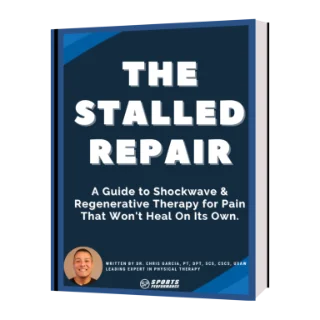
Before you book anywhere, read page 7
Most clinics that offer shockwave own one machine — usually the radial one. Radial energy spreads out near the surface, so if your problem sits deeper than that, it does not reach it.
Page 7 of our free guide explains the difference, roughly where your own problem sits, and what to ask before you book anywhere. Fourteen pages. No cost.
Send me the free guide →Your next step
Get the answer for your specific problem
Fifteen minutes on the phone, at a time you pick. You’ll find out whether shockwave therapy is likely to help you — including if it isn’t the right fit.
Book Your Free 15-Minute Call →
Or call or text (619) 397-1391.
Shockwave Therapy Chula Vista is a service of Sports Performance Physical Therapy. Shockwave therapy is not appropriate for every patient or every condition. Always consult a qualified healthcare provider about your specific condition.