
The Science
How Shockwave Therapy Actually Works
Not a massage gun. Not ultrasound. Not heat. Shockwave puts a controlled mechanical stimulus into tissue that has stopped repairing itself — and gets the repair started again. Here’s what that means, step by step.
Start Here
Your Problem Stopped Being An Inflammation Problem Months Ago
This is the part almost nobody explains, and it’s the reason the last three things you tried didn’t work.
What you were treated for
Rest it. Ice it. Anti‑inflammatories. Maybe a cortisone shot. That is the standard protocol for an acute injury, and for the first few weeks it is the right protocol.
But a tendon or fascia problem that has been dragging on for months is no longer inflamed in the way it was on day three. The word ending in “‑itis” stopped being accurate a long time ago.
What is actually going on
What researchers find in long‑standing tendon problems is degeneration, not inflammation — disorganised collagen, poor blood supply, and a repair process that started and then stalled.
Blood flow to a chronically injured tendon drops off. Without blood you don’t get the cells and nutrients repair needs. The body quietly files the job under “later” and moves on to something more urgent.
So ask what resting a stalled repair achieves. Nothing. You get a weaker version of the same problem. And that is also why cortisone felt brilliant for six weeks and then stopped — it turned the pain signal down. It never restarted the repair.
The Mechanism
What The Wave Does Once It’s In The Tissue
Four things happen, and they happen in order. The first is mechanical. Everything after it is biological.
1
A mechanical signal the cell can read
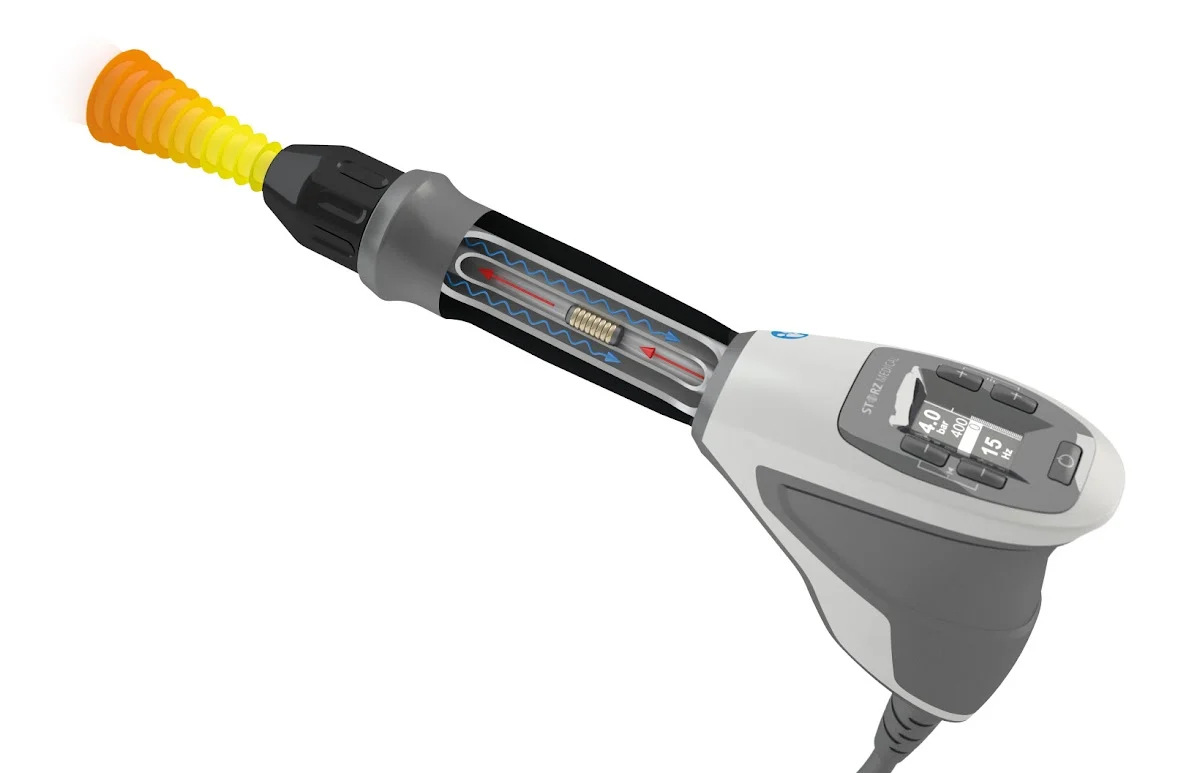
The wave is a pressure pulse, not heat and not electricity. Cells sense that mechanical load and convert it into chemical signalling — a process called mechanotransduction. In plain terms: the tissue is told, loudly, that something here needs attention.
2
New blood supply
The treated area releases growth factors that trigger the formation of new small blood vessels. That is the step that matters most, because the reason the repair stalled in the first place was that blood — and everything it carries — had stopped arriving.
3
Cells go back to work
With supply restored, the cells responsible for laying down new collagen become active again. This is why the change is gradual rather than instant, and why improvement often continues for weeks after your final session — you are building tissue, not masking a signal.
4
The pain alarm quiets down
The same energy appears to break up calcium deposits and disorganised scar tissue, and to desensitise the local nerve endings that have been keeping the area on high alert. Many clients notice this part first, before the tissue change has caught up.
In The Room
What A Session Actually Feels Like
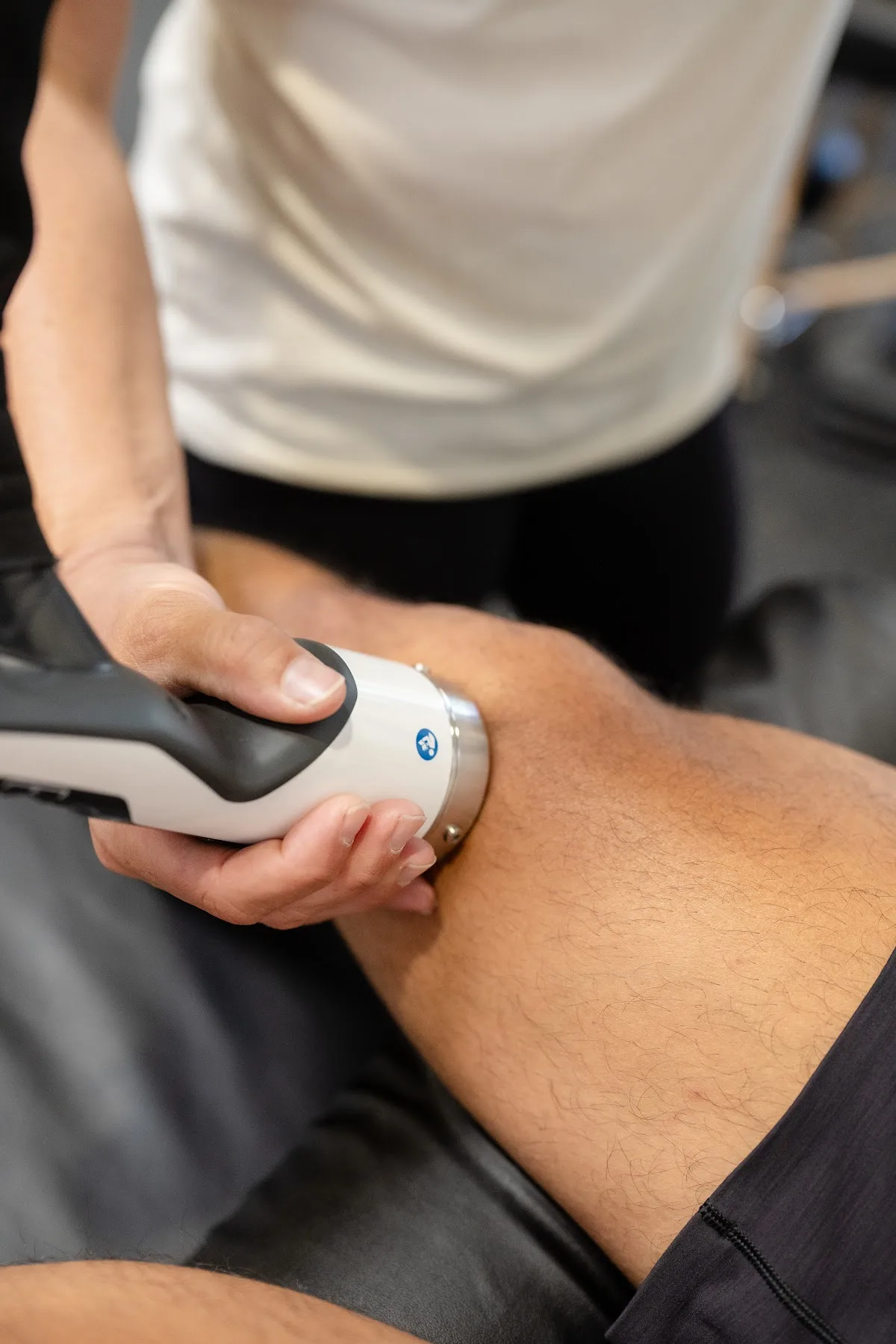
Gel goes on the skin, the same as an ultrasound. The handpiece is placed on the area and the energy is dialled up gradually — your therapist is watching your response the whole time and adjusting.
Most people describe it as a deep, rapid thumping. On a genuinely sore spot it is uncomfortable, and that is normal and expected; on healthy tissue an inch away it usually isn’t. Interestingly, finding the tender spot is part of how we confirm we are on the right structure.
Time on the area is five to ten minutes. The visit itself is 20 to 30 minutes, because treatment is only half of it.
Afterwards
You walk out, you drive yourself home, and you go back to your day. There is no sedation, no needle, no wound and no downtime.
Expect the area to feel sore or slightly heavy for a day or two — that is the treatment working, and it settles. We ask you to avoid anti‑inflammatories immediately after, because the whole point was to provoke a healing response and you don’t want to switch it back off. We’ll also usually ask you to keep loading the area in a specific way between visits.
The Course
Why It’s Six To Eight Sessions, Not One
A week apart, on purpose
Each session provokes a repair response. The week in between is when your body actually does the work. Stacking sessions closer together doesn’t speed that up — it just gets in the way of it.
Session two or three is where it shows
Most people notice a change somewhere in that window. Some feel it after the first. A small number feel nothing until the course is nearly done. None of those three is a bad sign on its own.
It keeps working after you stop
Because you are rebuilding tissue rather than blocking a pain signal, improvement typically continues for weeks after the last visit. We re-assess rather than assume.
How many you need depends on what is actually going on in there — six weeks of heel pain and four years of a bad Achilles are not the same job. That is settled at your assessment, not on a webpage.
Straight Talk
What Shockwave Will Not Do
We would rather lose a booking than take money for the wrong treatment.
× It will not fix a fresh, acute injury. If you hurt it last week, the inflammatory phase is doing its job and should be left alone.
× It will not regrow cartilage or reverse advanced arthritis. It can help with the pain and the soft tissue around an arthritic joint. That is a different claim.
× It will not repair a complete tendon rupture or a fracture. Those are surgical or immobilisation problems.
× It will not work if the diagnosis is wrong. Heel pain that is actually a nerve entrapment will not respond to treatment aimed at the plantar fascia. This is why we examine first.
× It will not hold if you skip the loading programme. New tissue has to be given a reason to organise itself. Treatment without progressive loading is half a job.
Not suitable if you are pregnant, have a bleeding disorder or are on blood thinners, have a tumour or active infection in the area, or a pacemaker or metal implant near the treatment site. We check all of this before we start.
Keep Reading
Where To Go Next
Our Three Machines →
Focused, radial and EMTT do different jobs. Why we run all three instead of one.
Conditions We Treat →
Whether your specific problem is one shockwave is actually good at.
Shockwave vs. Cortisone →
Why the shot felt like a miracle and then wore off.
Ask What Shockwave Costs
— And Whether You're A Candidate
One short form. A real conversation with our team.
On that call you'll get
✓ A straight answer on whether shockwave is likely to help your specific problem
✓ What a typical course involves — how many sessions, how far apart
✓ Exactly what it costs
✓ Whether something else would serve you better — including a referral elsewhere if that's the honest answer
✓ A time that works, if you decide to come in
No insurance required. No obligation. We'll come back to you within one business day.
Prefer to just ask? Call and we’ll answer the same questions on the spot.
Sports Performance Physical Therapy
861 Harold Place, Unit 307 · Chula Vista, CA 91914
(619) 397-1391
Mon–Thu 9:00am–6:00pm · Fri 8:00am–5:00pm
Serving Eastlake, Bonita, Otay Ranch, National City, Imperial Beach and San Ysidro. Kearny Mesa location also available.
Shockwave Therapy Chula Vista is a service of Sports Performance Physical Therapy. Shockwave therapy is not appropriate for every patient or every condition. Always consult a qualified healthcare provider about your specific condition.