
Lower Leg · Chula Vista · South Bay
Shin Splints & Chronic Calf Pain Treatment In Chula Vista
Shin pain that returns every time you build back up isn’t bad luck. It’s a bone and muscle that haven’t been given the capacity for what you’re asking of them.
✓ Non-surgical ✓ No injections ✓ No downtime ✓ 20–30 min visits
Start Here
What This Actually Is
“Shin splints” is a catch-all. The most common specific diagnosis is medial tibial stress syndrome — a stress reaction along the inner border of the shin bone where muscle and fascia attach, involving the bone’s outer layer and the surrounding soft tissue.
It sits on a spectrum. At the mild end it’s a periosteal irritation that settles with load management. At the severe end it becomes a tibial stress fracture, which is a different problem requiring rest and sometimes imaging — and one we screen for before we treat anything.
Chronic calf pain is a related but separate group: soleus and gastrocnemius tissue that has been repeatedly strained and never rebuilt, often in runners and field-sport athletes over 35.
The Real Problem
Why It Hasn’t Gone Away On Its Own
The classic cycle: pain, rest for two weeks, feel fine, return at the same volume, pain by week two. The rest removed the symptom without building any capacity, so the same load produces the same result.
Bone adapts to load slowly — considerably slower than muscle and cardiovascular fitness. Which means your legs are routinely the last part of you ready to run further, and the part that complains first.
It’s very often a training-load story rather than a tissue story: a jump in mileage, a change in surface, a new sport, a return after time off. Treating the shin without fixing that guarantees a rerun.
The Treatment
How Shockwave And EMTT Address It
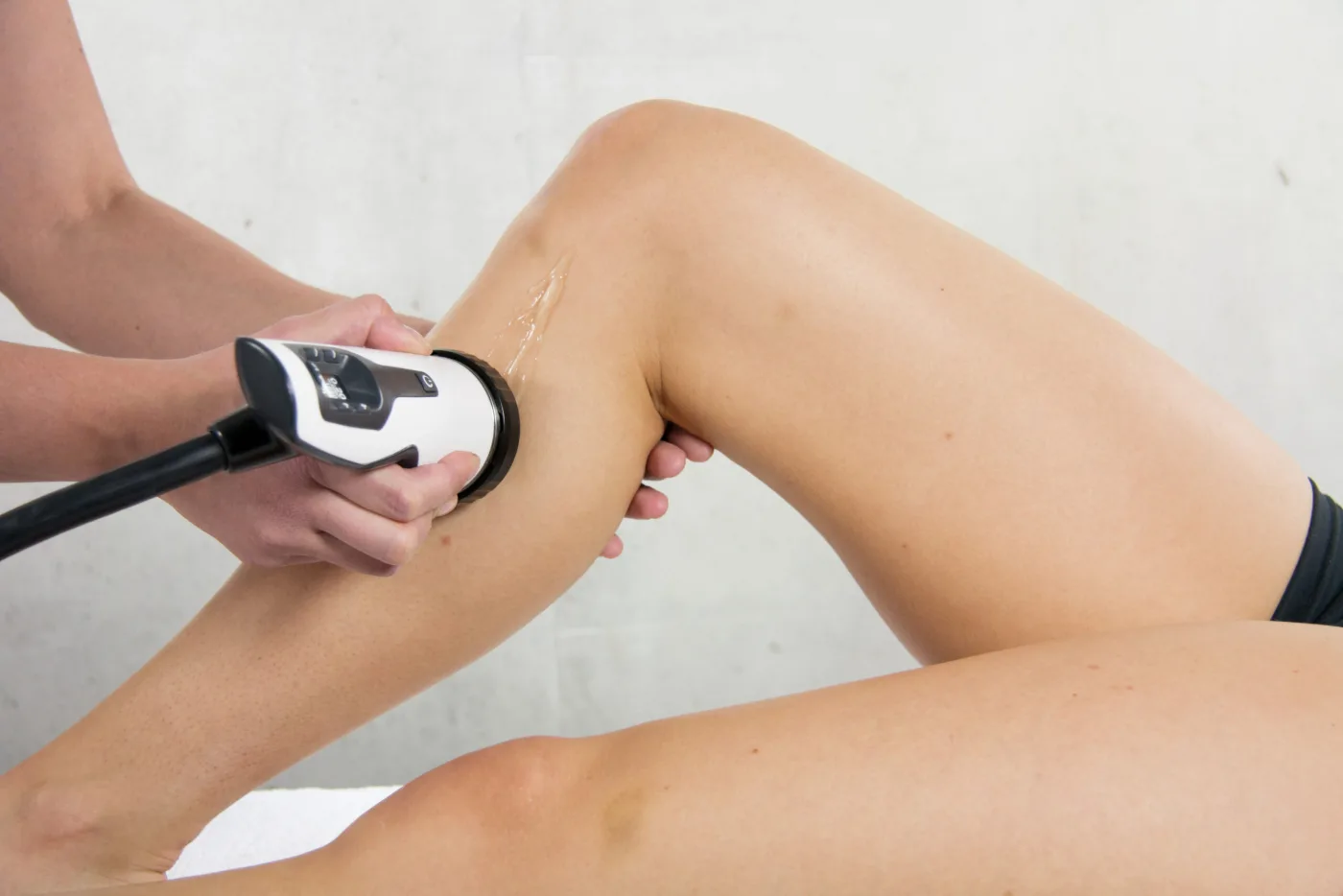
Shockwave delivers high-energy acoustic pressure waves into the tissue. The body reads that controlled stimulus as a fresh injury and reopens the healing process that stalled out. Here’s what that means for this specific problem.
A documented use for shockwave
Medial tibial stress syndrome is one of the more established shockwave indications, particularly for cases that haven’t settled with load management alone. It’s a bone-and-attachment problem, and shockwave has a real effect on bone response.
Stimulates bone healing response
Shockwave’s effect on osteoblast activity and local circulation is the same property that makes it useful in delayed bone healing. That’s the mechanism being used here.
Treats the soft tissue attachment
The posterior tibialis and soleus attachments along the medial shin are usually involved and usually tender. We treat them alongside the bone.
Gets athletes moving sooner
The value for a runner isn’t just less pain — it’s returning to training on a shorter timeline than “stop for six weeks and hope.”
What To Expect
What A Course Of Treatment Looks Like
Shins typically run six to eight sessions weekly, in parallel with a genuine load plan.
We will screen for stress fracture first. Focal bony tenderness over a small area, night pain or pain at rest changes the plan and may mean imaging before treatment.
The load plan isn’t optional here. Shockwave without a change in how you’re training is treating the symptom of a training error.
Straight Talk
Are You A Candidate?
Shockwave is genuinely good at a narrow set of problems. It is not good at everything, and candidacy is determined by examination, not by a website.
Shockwave Is Usually A Good Fit If
✓ Shin pain along the inner border that returns each time you build volume
✓ Pain that eases with rest and reliably comes back with running
✓ Diffuse tenderness over several centimetres rather than one point
✓ Chronic calf tightness or repeated calf strains
✓ You want to keep training rather than stop for two months
When It Isn’t The Answer
✗ Sharp, focal pain over one small spot of bone, night pain, or pain at rest — possible stress fracture, imaging first
✗ Pain with numbness or a tight, swollen compartment during exercise — possible exertional compartment syndrome, which is a surgical assessment
✗ Calf pain with swelling, warmth or redness — that needs urgent medical review to exclude a clot
✗ Active infection, open wound, tumour in the area, or pregnancy
If you’re in this column we’ll tell you on the first visit and point you where you should actually go. We’d rather lose the case than sell you sessions that won’t help.
Not Just A Machine
What We Do Besides Point A Device At You
Most clinics that own a shockwave device deliver shockwave. You’re seeing a Doctor of Physical Therapy, so you also get a diagnosis and a plan for why the tissue failed in the first place.
Calf and foot capacity
Loaded calf work, tibialis posterior strength, and foot intrinsics. Building the tissue that has to absorb the landing.
An actual training plan
Volume, surface, frequency, progression rate. Most shin cases are a load-management problem that got a medical name.
Running mechanics where it matters
Cadence and stride length can meaningfully change tibial load. We look at it when it’s relevant and leave it alone when it isn’t.
Weighing Your Options
Already Been Offered Something Else?
If you have a cortisone shot, an injection or a surgery on the table, these compare them honestly — including where the alternative is the better choice.
Your Next Step
Find Out If This Is Your Problem
Ask What Shockwave Costs
— And Whether You're A Candidate
One short form. A real conversation with our team.
On that call you'll get
✓ A straight answer on whether shockwave is likely to help your specific problem
✓ What a typical course involves — how many sessions, how far apart
✓ Exactly what it costs
✓ Whether something else would serve you better — including a referral elsewhere if that's the honest answer
✓ A time that works, if you decide to come in
No insurance required. No obligation. We'll come back to you within one business day.
Prefer to just ask? Call and we’ll answer the same questions on the spot.
Sports Performance Physical Therapy
861 Harold Place, Unit 307 · Chula Vista, CA 91914
(619) 397-1391
Mon–Thu 9:00am–6:00pm · Fri 8:00am–5:00pm
Serving Eastlake, Bonita, Otay Ranch, National City, Imperial Beach and San Ysidro. Kearny Mesa location also available.
Before you book anywhere, read page 7
Most clinics that offer shockwave own one machine — usually the radial one. Radial energy spreads out near the surface, so if your problem sits deeper than that, it does not reach it.
Page 7 of our free guide explains the difference, roughly where your own problem sits, and what to ask before you book anywhere. Fourteen pages. No cost.
Send me the free guide →Shockwave Therapy Chula Vista is a service of Sports Performance Physical Therapy. Shockwave therapy is not appropriate for every patient or every condition. Always consult a qualified healthcare provider about your specific condition.