
What Makes Us Different
Most Clinics Have One Machine. We Are The Only Clinic In San Diego County With All Three.
"Shockwave" isn’t one thing. Focused and radial waves do different jobs at different depths — and EMTT reaches tissue that neither one can. Running all three under one roof is why our results look different from a clinic with a single device.
The Problem With One Device
A Single Machine Means Your Problem Has To Fit The Machine
Buy one unit and every case starts looking like the case that unit treats well. That is not a criticism of the clinics doing it — the equipment is expensive. It is just a limitation you should know about before you book anywhere.
Depth is the whole argument
A plantar fascia sits a few millimetres under the skin. A gluteal tendon sits several centimetres down, under a layer of muscle. A calcific deposit in a rotator cuff is deeper still and needs energy concentrated on a point rather than spread across a region.
No single applicator does all three well. Energy that is right for one is either too diffuse or too concentrated for the others.
And some tissue takes no shockwave at all
An acutely irritable joint, a large volume of tissue, a body area too sensitive to tolerate mechanical pulses — there are cases where shockwave is either not tolerable or not enough on its own.
That is the gap EMTT fills, and it is why we bought it. It is completely painless and it passes through the whole joint rather than being applied to a point.
Machine one
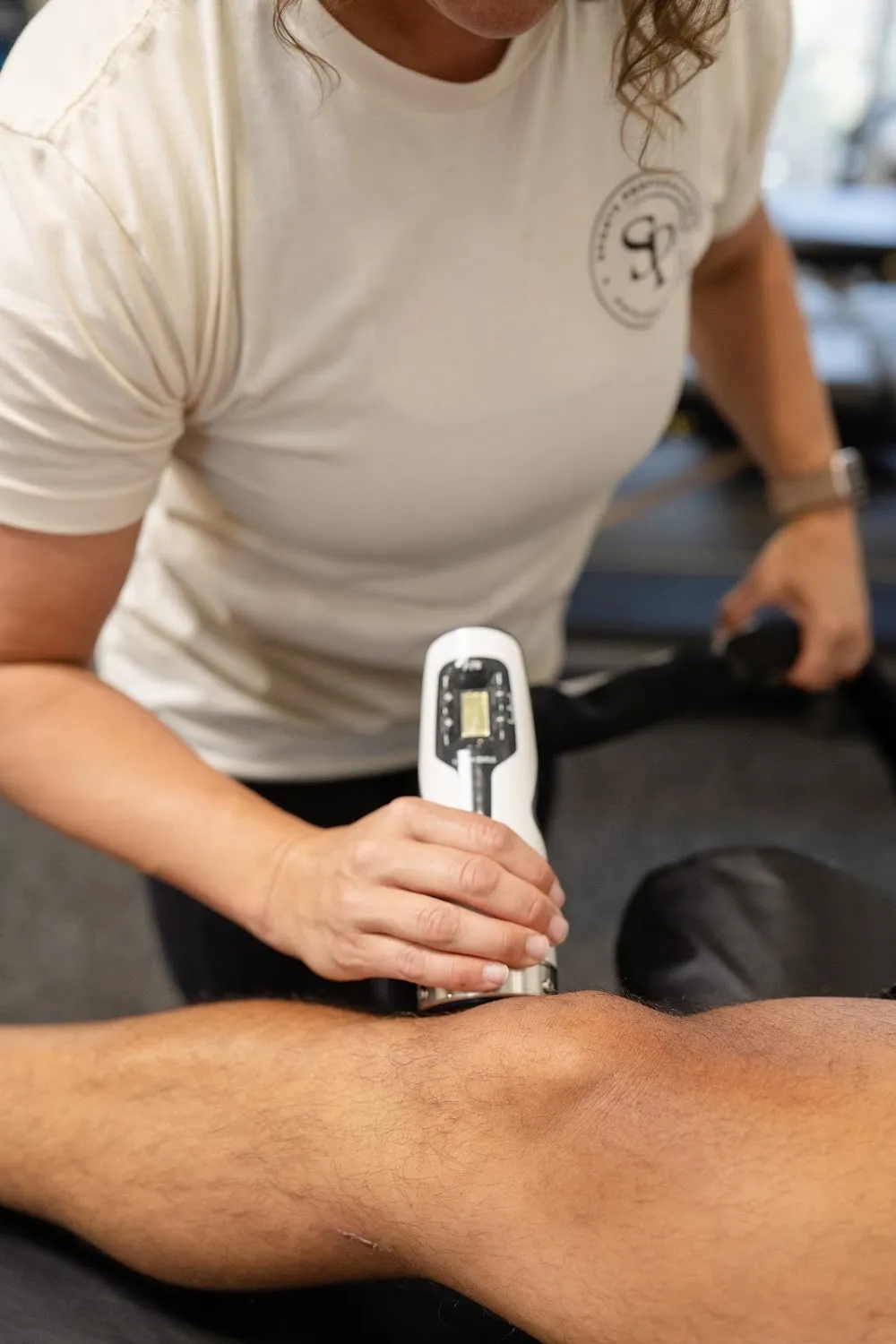
Focused Shockwave (ESWT)
Energy converged on a point, several centimetres beneath the surface. This is the one that reaches what a surface device cannot touch.
Best for: calcific rotator cuff, deep hip and gluteal tendinopathy, stubborn tendon insertion points, bone stress problems.
How it feels: a deep, precise thump. Uncomfortable on the sore spot, which is part of how we confirm we are on the right structure.
Depth: up to several centimetres, with the energy concentrated rather than spread.
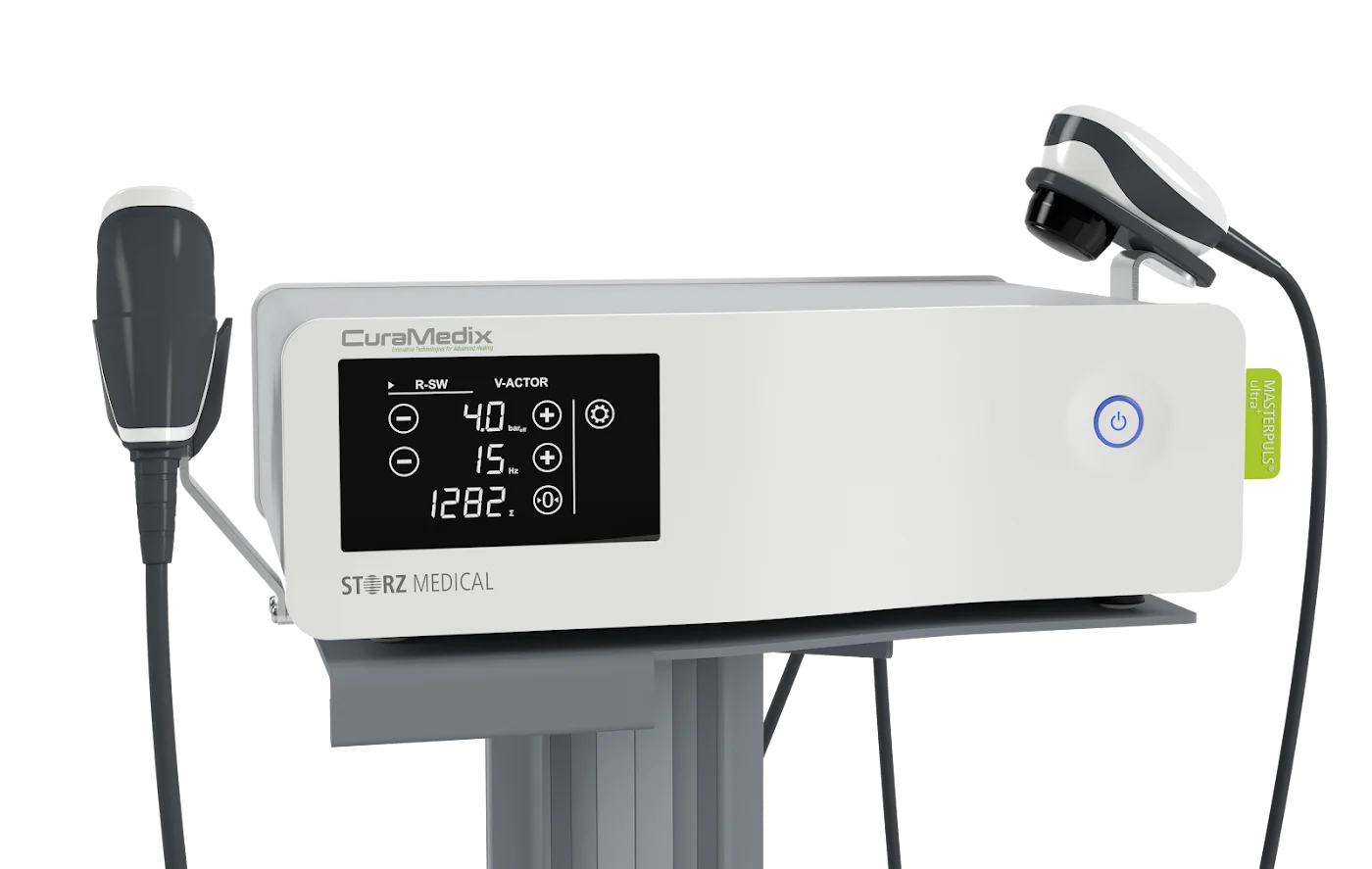
Our unit: Storz DUOLITH SD1 T-Top ultra
Machine two
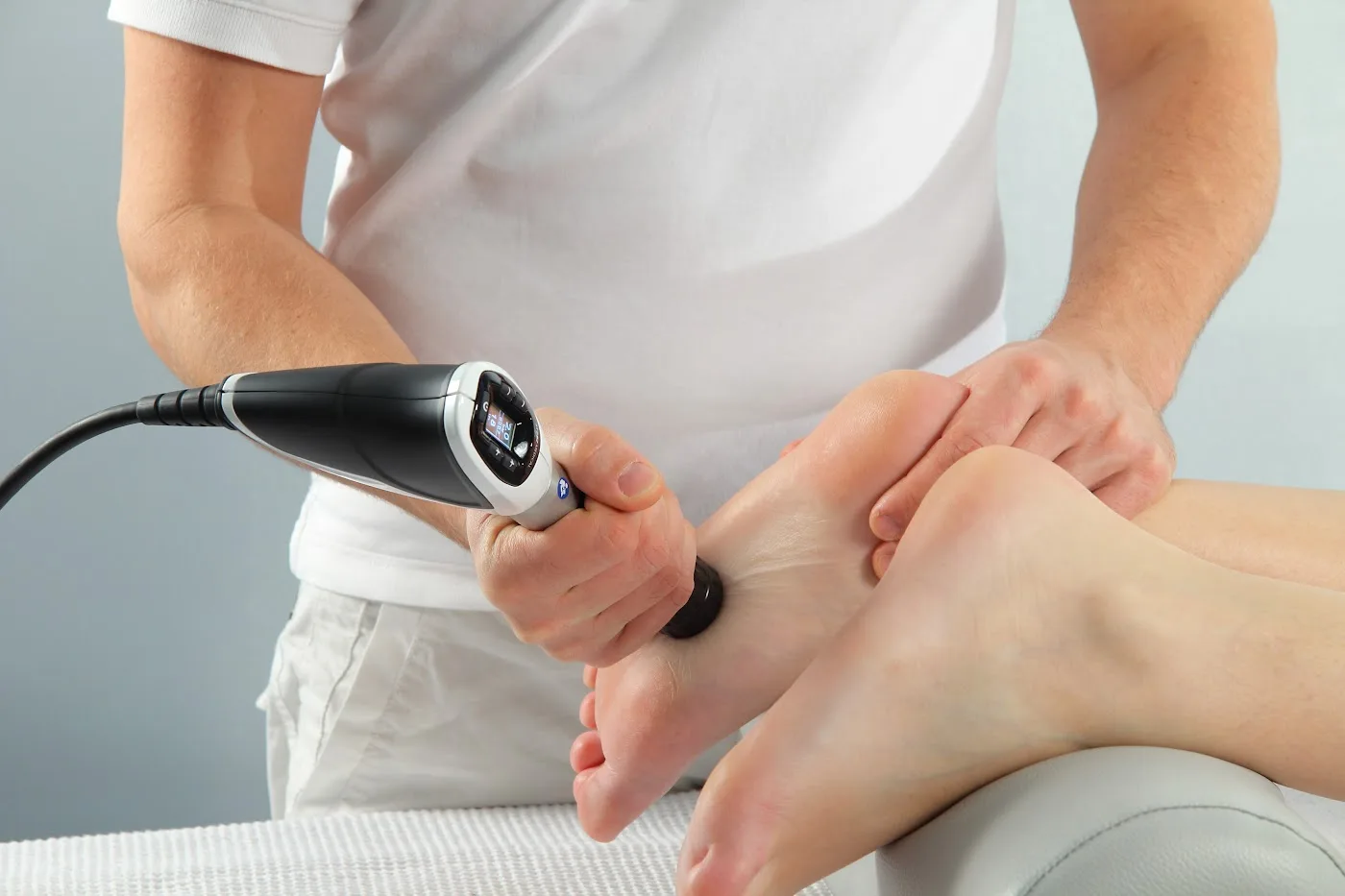
Radial Shockwave (EPAT)
Energy that spreads outward from the applicator and covers a whole region rather than a single point.
Best for: plantar fascia, IT band, calf, forearm, and widespread muscular soreness and trigger points.
How it feels: a broader, faster percussion — generally more tolerable than focused, over a wider area.
Depth: most of the energy stays in the first couple of centimetres, which is exactly what a superficial structure needs.
Our unit: OrthoPulse Ultra 100+ by Storz Medical
Machine three
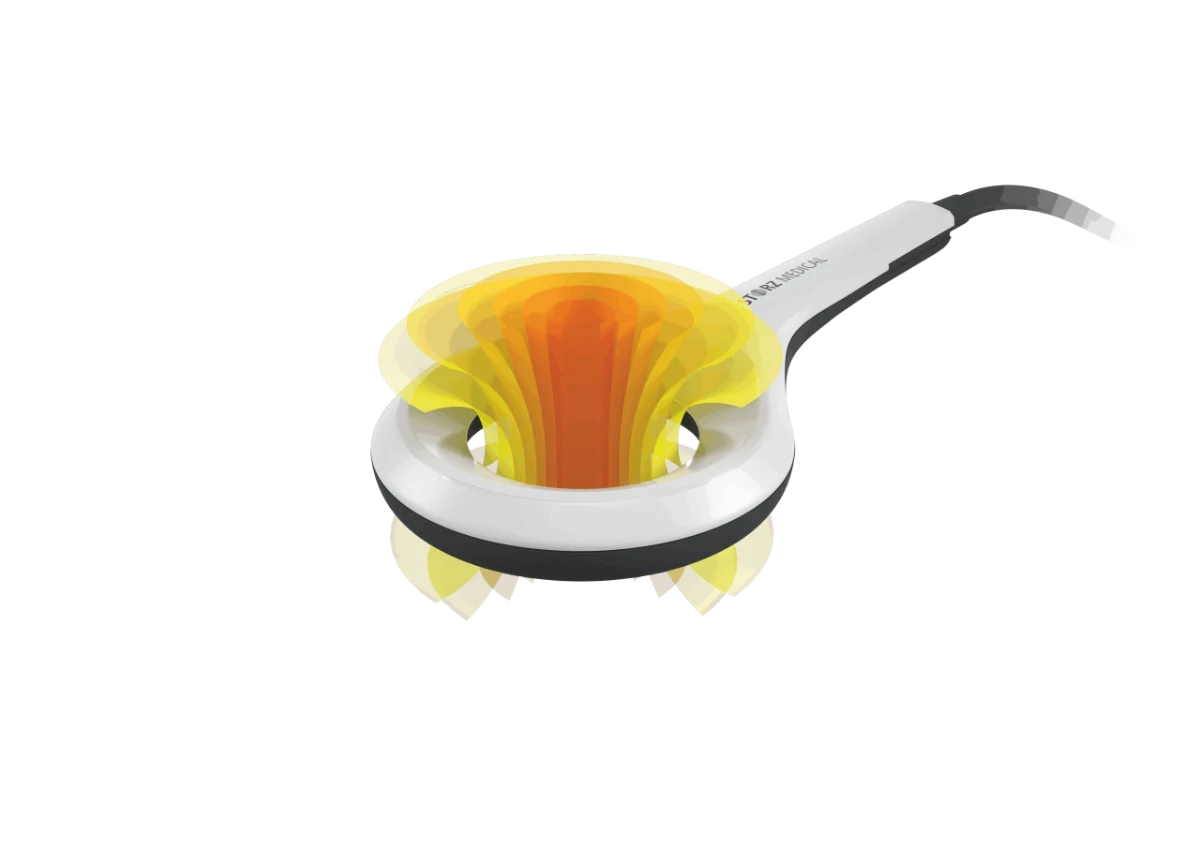
EMTT Magnetotransduction
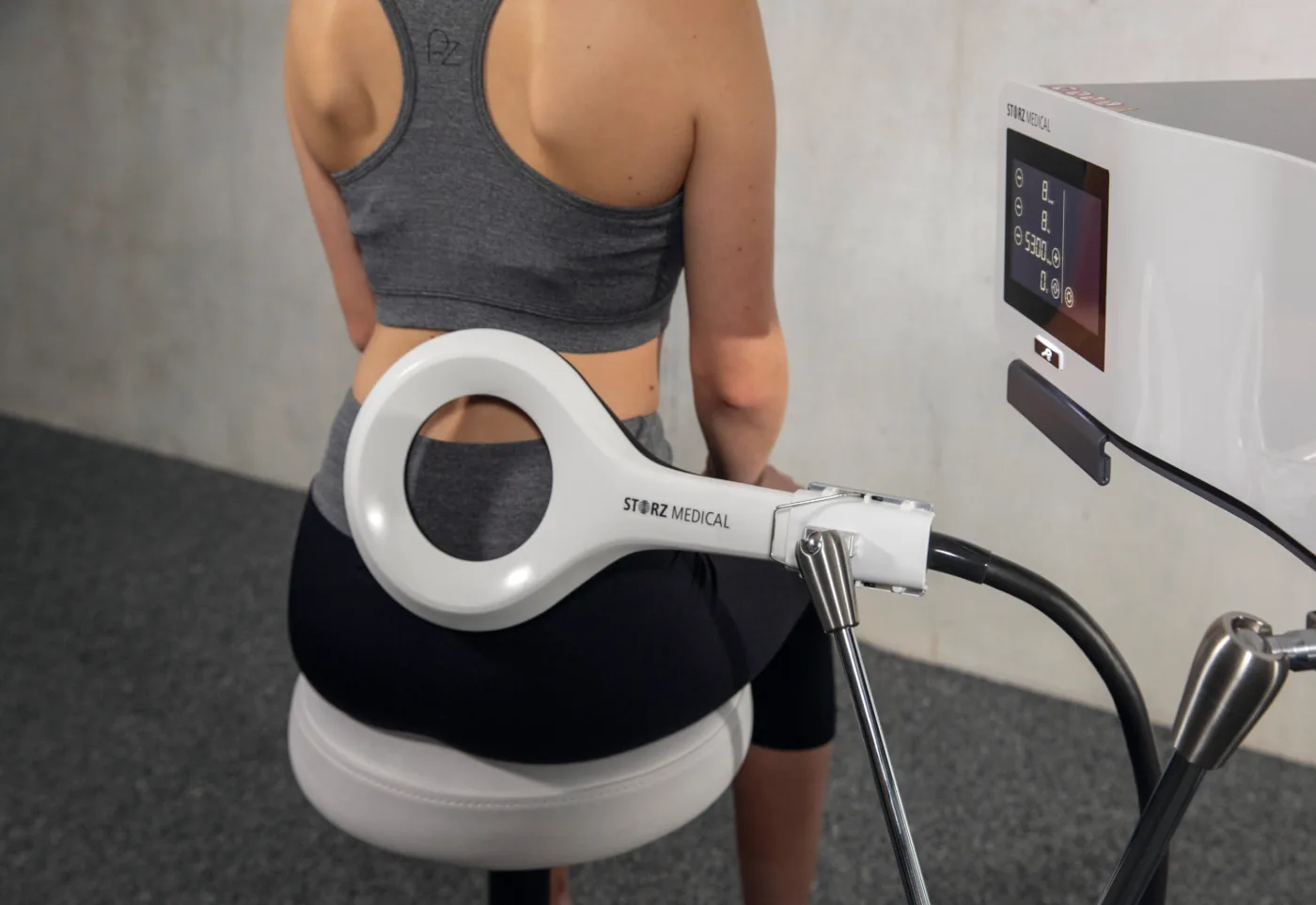
Not shockwave at all. High‑energy magnetic pulses that pass through the entire joint or region, targeting cell repair at a depth and volume that shockwave alone does not reach.
Best for: arthritic and irritable joints, larger regions such as the low back, and anyone who cannot tolerate mechanical pulses on the area.
How it feels: nothing. It is completely painless — you lie there and the applicator sits over the area. Most people find this the easy part of the visit.
Depth: the field passes through the whole structure rather than being applied to a surface.
Our unit: Storz MagnetoLith Plus
Side By Side
Which One Does What
Most courses use more than one of these. Which combination you get is decided at your assessment, based on the structure involved and how deep it sits — not by which machine happens to be free.
Our Protocol
Shockwave And EMTT Together Is The Standard Here
Shockwave provokes the repair mechanically. EMTT works on the cellular environment across a wider volume. Used in the same visit they are doing two different jobs on the same problem, and that combination is our default — not an upsell, and not something you will find at most clinics in the South Bay.
A typical visit runs 20 to 30 minutes: treatment, then the loading work that makes the new tissue hold up. If your case only needs one modality, that is what you will get and you will be told why.
And if you want to check us: the focused unit is a Storz DUOLITH SD1 T-Top, which holds FDA premarket approval P080028 for heel pain from chronic plantar fasciitis, and 510(k) clearance K202112. The EMTT unit is a Storz MAGNETOLITH, cleared under 510(k) K203710 for relaxing muscle spasm, increasing local blood circulation and maintaining or increasing range of motion — note that is a muscle-stimulator clearance, so using EMTT on a tendon or an arthritic joint is off-label, as most musculoskeletal shockwave is. Every device here is made by Storz Medical AG and you are welcome to look any of them up. What approved, cleared and registered actually mean →
Keep Reading
Where To Go Next
How It Works →
The mechanism, step by step — and what shockwave will not do.
Conditions We Treat →
Whether your problem is one these machines are actually good at.
Ask What Shockwave Costs
— And Whether You're A Candidate
One short form. A real conversation with our team.
On that call you'll get
✓ A straight answer on whether shockwave is likely to help your specific problem
✓ What a typical course involves — how many sessions, how far apart
✓ Exactly what it costs
✓ Whether something else would serve you better — including a referral elsewhere if that's the honest answer
✓ A time that works, if you decide to come in
No insurance required. No obligation. We'll come back to you within one business day.
Prefer to just ask? Call and we’ll answer the same questions on the spot.
Sports Performance Physical Therapy
861 Harold Place, Unit 307 · Chula Vista, CA 91914
(619) 397-1391
Mon–Thu 9:00am–6:00pm · Fri 8:00am–5:00pm
Serving Eastlake, Bonita, Otay Ranch, National City, Imperial Beach and San Ysidro. Kearny Mesa location also available.
Before you book anywhere, read page 7
Most clinics that offer shockwave own one machine — usually the radial one. Radial energy spreads out near the surface, so if your problem sits deeper than that, it does not reach it.
Page 7 of our free guide explains the difference, roughly where your own problem sits, and what to ask before you book anywhere. Fourteen pages. No cost.
Send me the free guide →Shockwave Therapy Chula Vista is a service of Sports Performance Physical Therapy. Shockwave therapy is not appropriate for every patient or every condition. Always consult a qualified healthcare provider about your specific condition.