
Knee & Tendon · Chula Vista · South Bay
Jumper’s Knee & Patellar Tendinopathy Treatment In Chula Vista
Pain at the bottom of the kneecap that shows up on jumping, squatting and stairs. Common in volleyball, basketball and lifting — and notorious for lasting years if it’s managed as an inflammation.
✓ Non-surgical ✓ No injections ✓ No downtime ✓ 20–30 min visits
Start Here
What This Actually Is
The patellar tendon connects the bottom of your kneecap to your shin bone and takes enormous load in jumping, landing and deep knee bend. Patellar tendinopathy — jumper’s knee — is degeneration at the tendon’s upper attachment, right at the inferior pole of the patella.
Like other tendinopathies it’s a structural problem, not an inflammatory one: disorganised collagen, abnormal vessel and nerve ingrowth, and a repair process that has stalled.
It has a distinctive behaviour. Pain is load-dependent and often quite specific — fine walking, awful on a decline squat — and it typically warms up, which encourages people to keep training through it.
The Real Problem
Why It Hasn’t Gone Away On Its Own
The tendon’s painful zone is on the deep surface at the attachment, which is compressed in deep knee flexion. Deep squats, long sitting and lunges keep provoking exactly the spot that needs to settle.
Athletes push through it because it warms up and because stopping means missing a season. The load continues through a tendon with no healing capacity.
Generic advice fails it specifically: quad stretching and deep-flexion mobility work tend to make patellar tendinopathy worse, not better.
The Treatment
How Shockwave And EMTT Address It
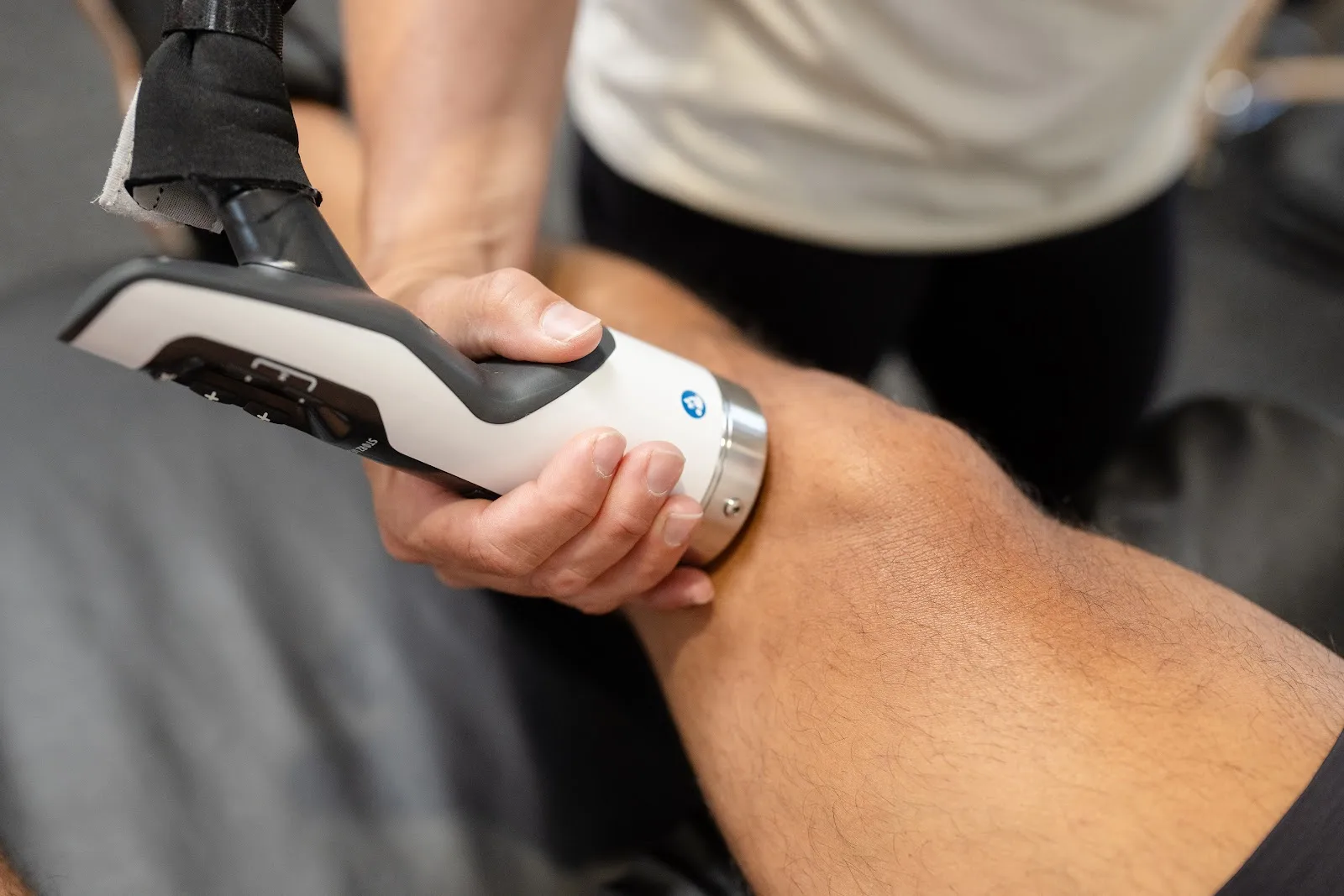
Shockwave delivers high-energy acoustic pressure waves into the tissue. The body reads that controlled stimulus as a fresh injury and reopens the healing process that stalled out. Here’s what that means for this specific problem.
Restarts repair at the attachment
The same mechanism as other tendinopathies — controlled micro-stimulus, new vessel growth, collagen turnover — targeted at the inferior patellar pole where the pathology lives.
Reduces pain so loading can start
Heavy slow resistance work is the best-supported treatment for this tendon. It’s also the thing people can’t tolerate. Shockwave’s practical value is making that loading achievable.
Precise targeting of a small area
The painful zone is often a couple of centimetres across. This is a good match for focused shockwave, where energy is concentrated rather than spread.
Keeps athletes in season where possible
For an in-season athlete, treatment that doesn’t require a shutdown period has obvious value. We’re realistic about what can be managed through and what can’t.
What To Expect
What A Course Of Treatment Looks Like
Patellar tendons usually need six to eight sessions weekly, and they are among the slower tendons to fully remodel — expect the tissue work to continue for a couple of months after the sessions finish.
We modify load rather than stop it: usually pulling back jumping, deep squatting and decline work while heavy slow quad loading goes in through a tolerable range.
If you’re mid-season, we’ll build the plan around your schedule and tell you honestly what that costs in timeline.
Straight Talk
Are You A Candidate?
Shockwave is genuinely good at a narrow set of problems. It is not good at everything, and candidacy is determined by examination, not by a website.
Shockwave Is Usually A Good Fit If
✓ Pain at the bottom of the kneecap lasting more than six weeks
✓ Pain on jumping, landing, squatting, stairs or after long sitting
✓ It warms up with activity and hurts more the next day
✓ You play a jumping sport or lift, and you don’t want to stop for a season
✓ Rest, straps and quad stretching haven’t changed it
When It Isn’t The Answer
✗ A sudden pop with inability to straighten the knee or lift it — possible tendon rupture, urgent referral
✗ Pain behind or around the kneecap rather than at its lower pole — that’s usually patellofemoral pain, a different problem
✗ Swelling inside the joint, locking or catching — needs imaging
✗ Adolescents with pain at the growth plate — Sinding-Larsen or Osgood-Schlatter needs age-appropriate management
✗ Active infection, open wound, tumour in the area, or pregnancy
If you’re in this column we’ll tell you on the first visit and point you where you should actually go. We’d rather lose the case than sell you sessions that won’t help.
Not Just A Machine
What We Do Besides Point A Device At You
Most clinics that own a shockwave device deliver shockwave. You’re seeing a Doctor of Physical Therapy, so you also get a diagnosis and a plan for why the tissue failed in the first place.
Heavy slow resistance for the quad
The core of patellar tendon rehab. Progressed by tolerance, through a range the tendon accepts.
Landing and jumping mechanics
How you absorb landing determines how much the tendon takes. Worth fixing if you intend to keep jumping.
Hip and calf contribution
A knee that takes all the load usually has a hip or a calf that isn’t taking its share.
Weighing Your Options
Already Been Offered Something Else?
If you have a cortisone shot, an injection or a surgery on the table, these compare them honestly — including where the alternative is the better choice.
Your Next Step
Find Out If This Is Your Problem
Ask What Shockwave Costs
— And Whether You're A Candidate
One short form. A real conversation with our team.
On that call you'll get
✓ A straight answer on whether shockwave is likely to help your specific problem
✓ What a typical course involves — how many sessions, how far apart
✓ Exactly what it costs
✓ Whether something else would serve you better — including a referral elsewhere if that's the honest answer
✓ A time that works, if you decide to come in
No insurance required. No obligation. We'll come back to you within one business day.
Prefer to just ask? Call and we’ll answer the same questions on the spot.
Sports Performance Physical Therapy
861 Harold Place, Unit 307 · Chula Vista, CA 91914
(619) 397-1391
Mon–Thu 9:00am–6:00pm · Fri 8:00am–5:00pm
Serving Eastlake, Bonita, Otay Ranch, National City, Imperial Beach and San Ysidro. Kearny Mesa location also available.
Before you book anywhere, read page 7
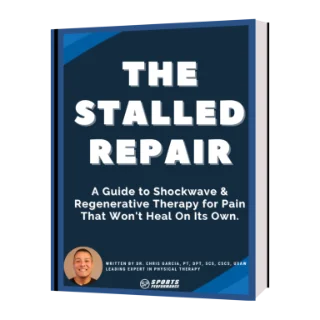
Most clinics that offer shockwave own one machine — usually the radial one. Radial energy spreads out near the surface, so if your problem sits deeper than that, it does not reach it.
Page 7 of our free guide explains the difference, roughly where your own problem sits, and what to ask before you book anywhere. Fourteen pages. No cost.
Send me the free guide →Shockwave Therapy Chula Vista is a service of Sports Performance Physical Therapy. Shockwave therapy is not appropriate for every patient or every condition. Always consult a qualified healthcare provider about your specific condition.