
Shockwave vs. Surgery
Surgery Is A One-Way Door. Try The Reversible Option First.
If someone has recommended an operation for chronic tendon or fascia pain, you owe yourself one conversation before you schedule it. Shockwave costs a fraction, carries no surgical risk, and doesn’t close off a single option if it doesn’t work.
Straight Talk
When Surgery Is The Right Answer
There are cases where an operation is clearly indicated, and we will tell you so and help you get to the right surgeon.
✓ A complete tendon rupture or a full-thickness tear with functional loss
✓ Progressive neurological signs — significant weakness, numbness, loss of bowel or bladder control
✓ Significant structural instability or a displaced fracture
✓ Advanced end-stage joint arthritis where the joint surface itself is gone
✓ An unstable, locking or blocked joint that genuinely won’t move
Most chronic tendon and fascia pain is none of these. Plantar fasciitis, tennis elbow, patellar and Achilles tendinopathy, gluteal tendinopathy and calcific rotator cuff tendonitis are, in the great majority of cases, problems of failed healing — not problems of broken architecture.
Side By Side
Shockwave + EMTT vs. Surgical Intervention
| Shockwave + EMTT | Surgery | |
|---|---|---|
| Reversible | Yes — nothing is altered permanently | No |
| Anesthesia | None | General or regional |
| Time off work | None | Weeks to months, role dependent |
| Recovery | Walk out, drive yourself home | Immobilization, then months of rehab |
| Risk profile | Temporary soreness, occasional bruising | Infection, nerve injury, anesthesia risk, blood clots, scar tissue, stiffness |
| Cost order of magnitude | $ | $$$$$ — plus lost income |
| Rehab required afterward | Yes — and it starts immediately | Yes — and it starts weeks later |
| Keeps other options open | All of them | Revision surgery is harder than first surgery |
| If it doesn't help | You've lost weeks, not your anatomy | You are past the point of undoing it |
The Honest Case
Three Things Worth Knowing Before You Schedule
None of this is an argument against your surgeon. It’s an argument for exhausting the reversible options first.
Imaging Findings Are Not Always The Pain
Studies of pain-free adults routinely find rotator cuff tears, meniscus tears, disc bulges and tendon degeneration on MRI in people with no symptoms at all. A finding on a scan is not automatically the thing that hurts — which is why examination matters as much as imaging.
Some Common Operations Have Been Challenged
Several widely performed orthopedic procedures for degenerative pain have not outperformed placebo or structured non-surgical care in high-quality randomized trials. Ask your surgeon directly what the evidence shows for your specific procedure and diagnosis.
You Rehab Either Way
Every good surgical outcome still ends in months of physical therapy. If loading and tissue quality are going to determine the result regardless, it is reasonable to find out what they can do before the incision.
What We’ll Do
Bring Us The Surgical Recommendation
Come in with your imaging report and your surgeon’s notes. In one visit you’ll get a second set of eyes and a clear read on whether there’s a non-surgical path worth trying first.
1
We Read What You Were Told
Imaging report, diagnosis, the proposed procedure. We’ll translate it into plain English and tell you what it does and doesn’t address.
2
We Examine You Ourselves
The 27-point assessment tests whether your symptoms actually match the structure named on the scan — and whether the tissue still has healing capacity.
3
You Get A Straight Recommendation
Sometimes that recommendation is “go have the surgery.” When it is, we’ll say so plainly — and we’ll be here for the rehab afterward.
Questions
Surgery & Shockwave FAQ
My surgery is already scheduled. Is it too late to try this?
Talk to us and to your surgeon. Depending on the diagnosis and how far out the date is, a short trial of shockwave is sometimes reasonable. We will never advise you to cancel an operation — that decision belongs to you and your physician.
How long before I know if it's working?
Most patients have a clear signal within 3 to 4 sessions — roughly a month. That’s a short window relative to a surgical recovery.
Will trying shockwave first make surgery harder later?
No. Shockwave doesn’t alter surgical anatomy or create scarring that complicates a later procedure.
What if I've already had surgery and I'm still in pain?
That’s a common reason people find us. Shockwave and EMTT are frequently used for post-surgical scar tissue, stiffness and persistent tendon pain. Bring your operative report.
Do you talk to my surgeon?
Gladly, with your permission. Good outcomes come from the surgeon, the therapist and the patient working from the same plan.
Your Next Step
Get A Straight Answer Before You Decide
Before you commit to surgery, find out whether your problem is one shockwave actually solves — and what it would cost. Asking costs you nothing.
Ask What Shockwave Costs
— And Whether You're A Candidate
One short form. A real conversation with our team.
On that call you'll get
✓ A straight answer on whether shockwave is likely to help your specific problem
✓ What a typical course involves — how many sessions, how far apart
✓ Exactly what it costs
✓ Whether something else would serve you better — including a referral elsewhere if that's the honest answer
✓ A time that works, if you decide to come in
No insurance required. No obligation. We'll come back to you within one business day.
Prefer to just ask? Call and we’ll answer the same questions on the spot.
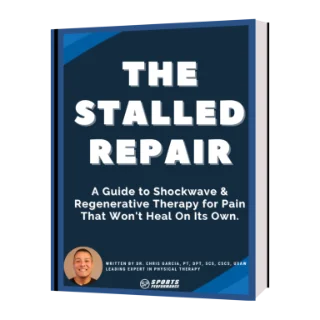
Before you book anywhere, read page 7
Most clinics that offer shockwave own one machine — usually the radial one. Radial energy spreads out near the surface, so if your problem sits deeper than that, it does not reach it.
Page 7 of our free guide explains the difference, roughly where your own problem sits, and what to ask before you book anywhere. Fourteen pages. No cost.
Send me the free guide →Comparisons on this page describe treatments in general terms and are not a substitute for a conversation with your own physician or surgeon.